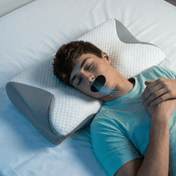



Breathing seems like something you do not have to think about. During sleep, though, quite a lot depends on whether the air comes in through the nose or through the mouth.
What the nose can do and the mouth cannot
The nose is not merely a passage. It filters particles, warms the air to body temperature and humidifies it before it reaches the lungs. The mouth skips all of that. Anyone who breathes through the mouth at night knows the consequences: a dry throat in the morning, chapped lips, the feeling of not having drunk enough.
Then there is the mechanics. With the mouth open, the lower jaw drops back, and the base of the tongue moves with it. The airways become narrower — and a narrower channel produces more noise. That is why mouth breathers snore more often.
What studies on nasal strips show
External nasal dilators — that is, strips that lift the nostrils from the outside — are comparatively well researched. They measurably reduce resistance in the nose.
A randomised, placebo-controlled study in people with chronic night-time nasal congestion compared two types of strip with an inactive placebo strip over two weeks. Both real strips performed significantly better on sleep satisfaction than the placebo.
Where the limit lies
One point belongs here, even if it is inconvenient: in investigations of pronounced snoring, a worsening of the apnoea-hypopnoea index was observed in isolated cases. A nasal strip is therefore not a remedy for sleep apnoea, and we do not position it as one.
What it can do: make the nose freer when the nose is the bottleneck. What it cannot do: heal a blocked nose or treat a breathing disorder.
How our products fit in
We have two approaches in our range, and each starts at a different point.
The AirStrip works from the outside of the nose and clears the way so that more air can be taken in. The SleepTape works at the mouth and supports breathing taking the route through the nose in the first place. One thing matters here: our strip is air-permeable. If you want to or have to breathe through your mouth, you can do so at any time — it holds the lips together gently, it does not seal them.
Both are comfort products. They make a habit easier and give support, but they do not treat anything.
What you can check yourself
Waking up with a dry mouth? That is the clearest sign of mouth breathing at night. If you get air through your nose poorly during the day, the bottleneck is probably there — in which case a nasal strip is the closer approach. If the nose is clear and the mouth is open anyway, it is more likely to be habit.
What works for you is something you will find out best by trying it. That is why our satisfaction guarantee applies here too, and if you have questions our team in Switzerland is there for you.
Sources
- Effects of nasal dilator strips on subjective measures of sleep in subjects with chronic nocturnal nasal congestion: a randomized, placebo-controlled trial. Allergy, Asthma & Clinical Immunology, 2018. Read the full text
- Clinical Effectiveness of Nasal Dilators in Sleep-Disordered Breathing: A Systematic Review and Meta-Analysis. Read the review